Hana Hou Magazine – Hawaiian Airlines – June, 2026
STORY BY D E R E K F E R R A R
PHOTOGR APHY BY E LYS E B UTLE R
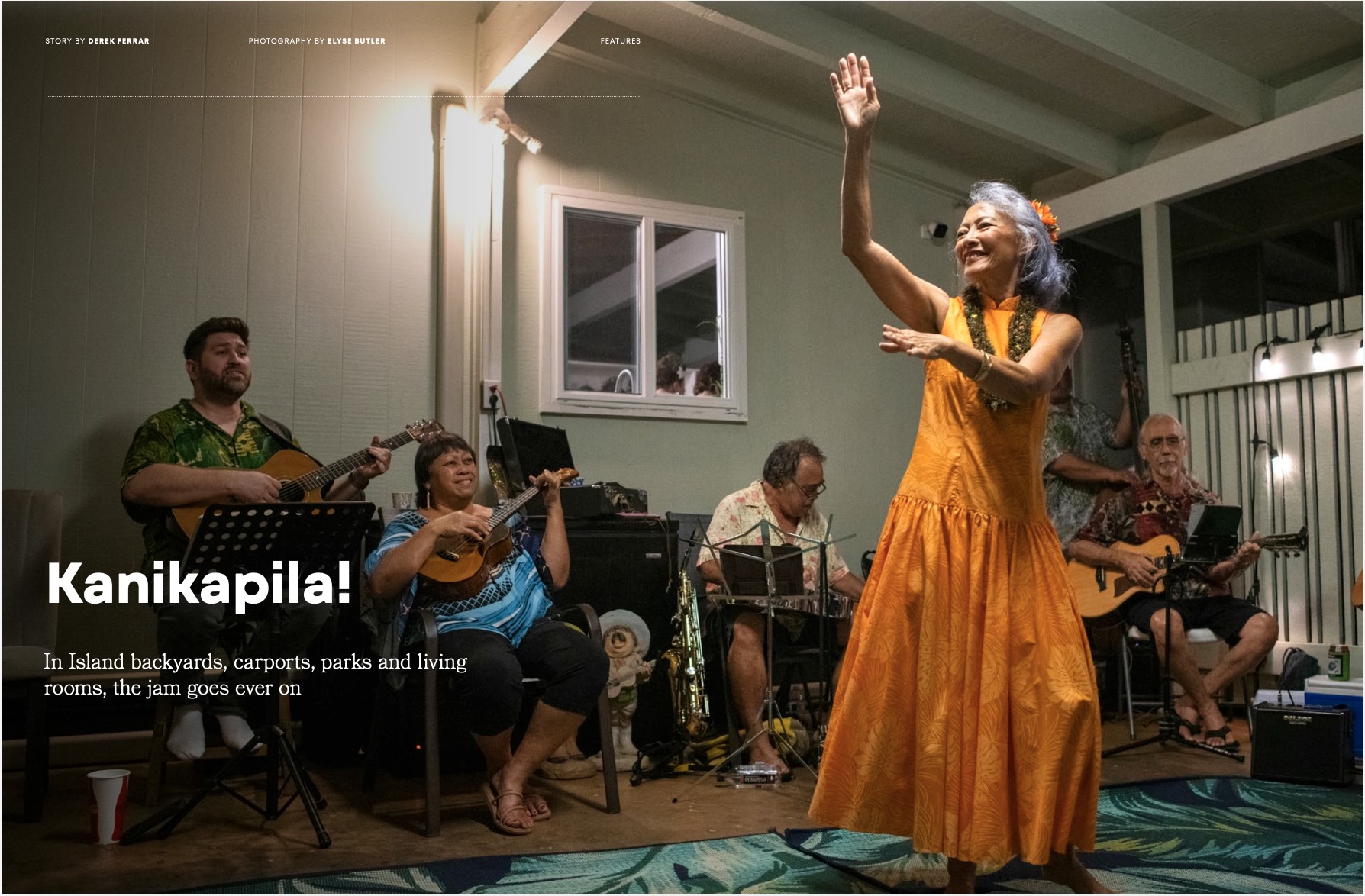
producer/pe!ormer Imua Garza and his mother, Pam (both at left). “Every time we got together, there was music,” says Pam, who grew up in a family of old-time Hawaiian musicians. “You don’t have to say, ‘Hey, bring a guitar’—they just bring it. Our friends are like that.”
In Island backyards, carports, parks and living rooms, the jam goes ever on
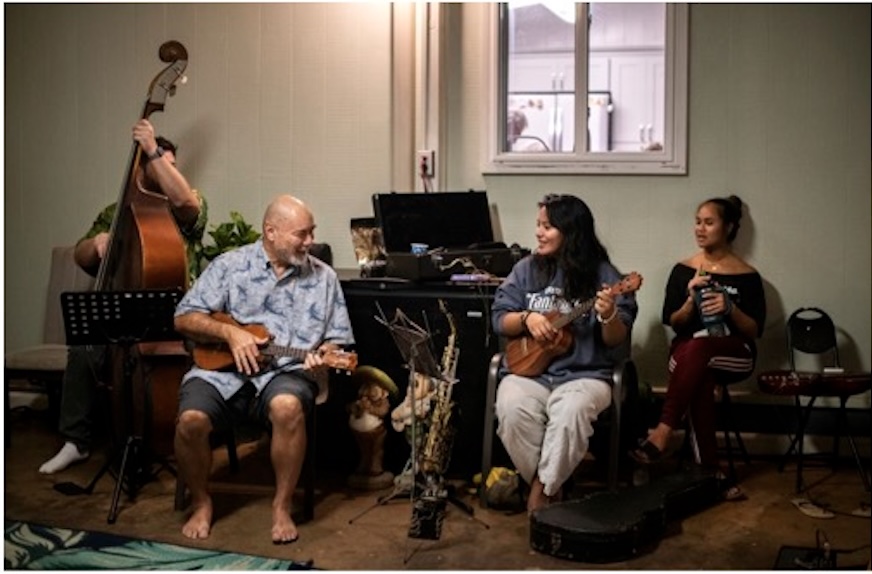
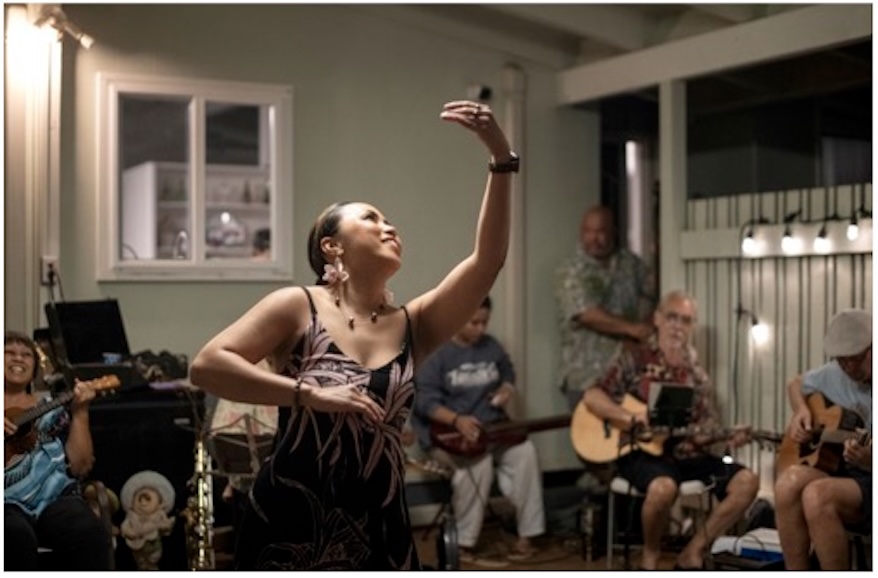
a hula number at the Garza family kanikapila.
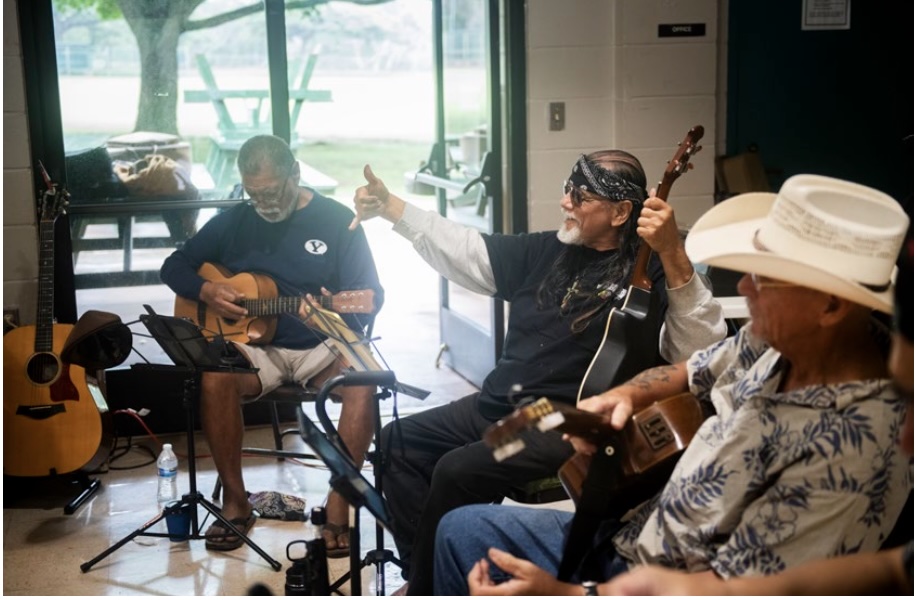
leads a “Kanikapila Group Therapy” session on Moloka‘i alongside fellow Hawaiian Airlines retiree Sterling Kalua (at left) and paniolo (Hawaiian cowboy) Phil ‘Unco Mango’ Stephens
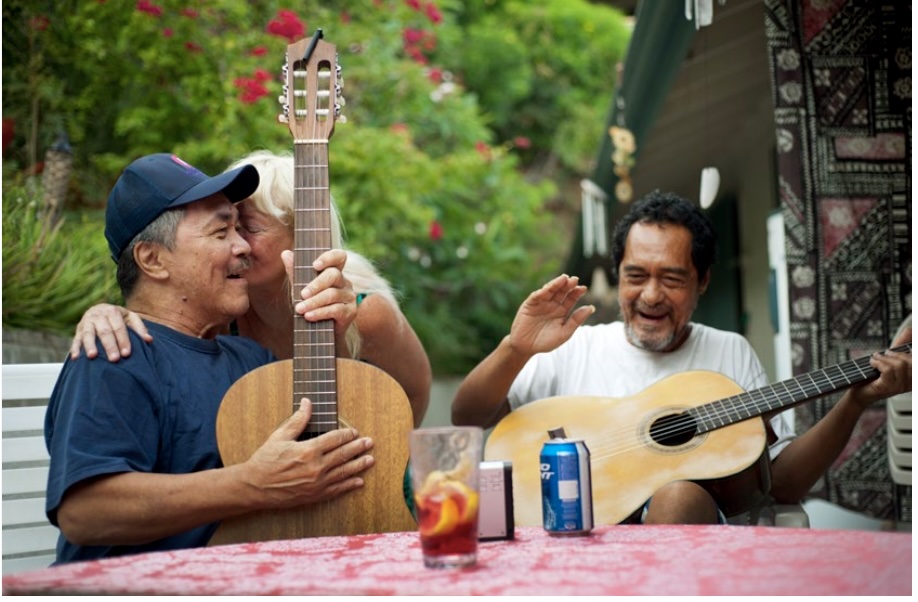
On a quiet evening in the suburban hills above Pearl Harbor, music and laughter waft from an illuminated carport. Inside, a circle of around twenty friends and relatives of the musical Garza family ring the walls on folding chairs, many with guitars or ‘ukulele in hand. A steel
guitar sings out with its signature glide as a chorus of voices lets loose on series of familiar Hawaiian favorites, occasionally accompanied by several generations of hula dancers.
There’s no setlist here. Someone calls out a song name or starts noodling
a tune, and everyone jumps in. One uncle blows along unexpectedly on sax,
while a younger player thumps along on a single-string washtub bass—called
a pakini in Hawaiian music, after the term for tin basin. Meanwhile, Marge
Garza, the 93-year-old matriarch of the ‘ohana, or extended family, captures the
action on her bejeweled smartphone. The gathering is what’s known
locally as a kanikapila—a colloquial Hawaiian term that loosely translates
as “let’s play music!”—a cherished tradition of informal backyard jam
sessions where everyone is free to join in, just for the chee-hoo of it. Among
the jammers at the Garzas’ are a few recognizable stars, like the well-known
singer “Sistah Robi” Kahakalau, young steel guitar sensation M!lie Lyman
and the family scion Imua Garza, an award-winning Island music producer
and front man of the popular reggae-flavored band the Opihi Pickers. But
most of the players here are just regular folks with varying levels of ability and a
shared musical passion. “In this garage, everybody who comes along is included,
and nine out of ten people play pretty good,” Robi says. “And if they’re not
playing, they’re dancing.”
Like most social gatherings in Hawai‘i, kanikapila get-togethers are
nearly always accompanied by copious buffets of potluck “grinds.” Taking
a break from the music to hit the multicultural spread of local comfort
food ranging from k!lua pig and squid lū‘au to sushi and lo mein noodles laid
out on his mom’s kitchen counter, Imua says that growing up around these
gatherings inspired his music career. “While the other kids were outside
playing football or whatever, I was the one that was always in the circle,” he
says. “At first I would just watch, and later on maybe grab an ‘ukulele and play
along quietly. Then eventually I started jumping in on guitar or bass if they
needed one, and I just kind of learned on the spot. But I definitely don’t think
I would be making music full-time now if it wasn’t for these little circles that
really got me started.”
The Garza ‘ohana kanikapila has its origins in the “Hawaiian
Renaissance” of the 1970s, when Indigenous culture, language and
activism blossomed amid the era’s wave of social-change movements around the
world. Imua’s aunt, Chelo Ka‘i‘ini Garza- Maguire, recounts being a student of
‘ōlelo Hawai‘i, or Hawaiian language under pioneering teacher Larry
Kauanoe Kimura at the University of Hawai‘i. “Our language classes were
held five days a week, but Fridays were ‘culture day,’” she remembers, “which
meant singing, playing and dancing. We didn’t really realize it at the time, but
through the music we were learning Hawaiian culture, vocabulary and
thinking. Plus, everybody had good fun.”
The students started up a club to promote Hawaiian language and
culture called Hui Aloha ‘Aina Tuahine, after the misty Tuahine rains of M!noa
Valley where the university is located. The club went on to play an influential
role in the burgeoning cultural revival, including working on a groundbreaking
Hawaiian-language interview program on the commercial radio station KCCN.
“We didn’t know then that we were part of what people would later call the
Hawaiian Renaissance,” Garza-Maguire recalls. “We didn’t think about it; we
just did it.”
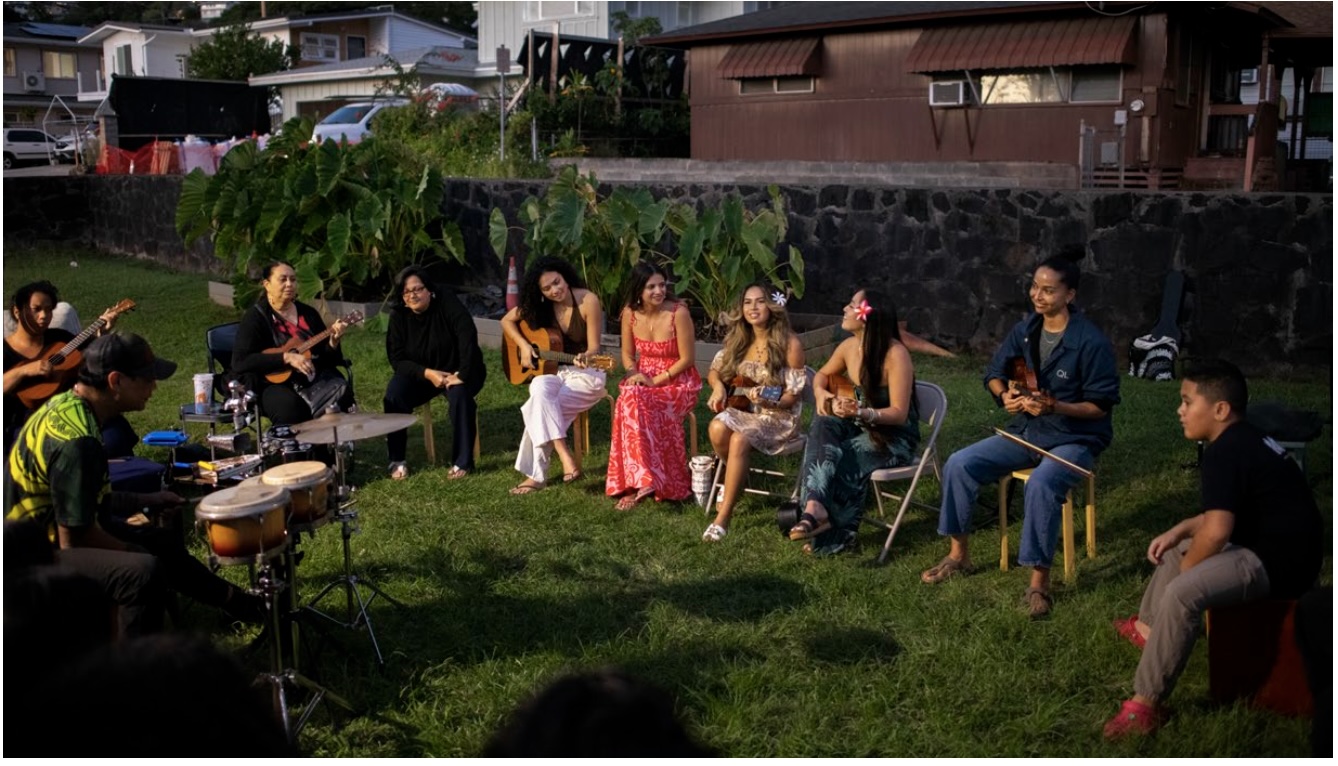
Musicians affiliated with the Mana Maoli arts, culture and community-based education collective, jam with youngsters at a monthly
kanikapila gathering. “Kanikapila is essential to our culture, because it’s where we gather as one,” says one young participant. “It gives us the
chance to share harmony and true aloha, and strengthens the bonds of ‘ohana that carry our music and identity forward.”
Later in life, members of the club started holding periodic reunion parties with music and hula, and these gatherings eventually evolved into broader kanikapila sessions spearheaded by Chelo’s husband, Keoki Maguire, a slack key guitarist and pillar of the Hawaiian music community. At their high point, the musical get-togethers happened every other month
at various people’s homes, but then COVID intervened and later the ‘ohana lost Keoki and other key elders, so the kanikapila went dark for a few years. Only recently did Imua’s mom Pam
decide to start reconvening the tradition at the family home a few times a year.
“We’re really inspired to continue this,” Imua says. “I mean, you see the joy that
it brings to everyone, and the way that music brings us all together. It’s instant, you know?”
One of the standouts at this evening’s gathering is twenty-something lap steel player and singer M!lie Lyman, who is carrying forward the traditions of her well-known musical family,
including her great-grandmother, the Hawaiian falsetto diva Auntie Genoa Keawe, famed for holding impossibly long high notes. Even as an up-and-coming Lyman says she appreciates the informal kanikapila jams because “we’re not here to perform; this is just for everybody’s
individual enjoyment, to learn and have fun. And it’s great being surrounded by people like these who all have different ‘ike, or insights, into the music.”
According to scholar George Kanahele’s Hawaiian Renaissance-
era encyclopedia Hawaiian Music and Musicians, the term kanikapila—
used as both a noun and a verb and sometimes divided up as “kani ka
pila”—is something of a slang phrase derived from the more formal “ho‘okani
mai ka pila.” And “Pila,” meaning a musical instrument, particularly a
stringed one, is actually a loanword from English that derives from the
Hawaiian pronunciation of “fiddle,” once a common instrument in Hawai‘i
following the arrival of Westerners and their music at the end of the 1700s. “Kani,” meanwhile, simply means a sound, or to make one.
Although the term kanikapila may be relatively recent in the Hawaiian
lexicon, University of Hawai‘i ethnomusicologist Ricardo Trimillos
points out that oral traditions and early written accounts mention informal
occasions in traditional Hawaiian society when people would compose chants or hula on the spot to entertain one another, sometimes as a form of teasing or competition. Such under-
the-radar everyday practices later helped preserve critical cultural links
through the dark decades during which performances of hula, chant and other
traditions were subjected to bans under the influence of early missionaries and their heirs.
Slack key guitar icon Ledward Kaapana often talks about the
kanikapila culture of his off-the-grid upbringing in the isolated village
of Kalapana, then an idyllic coastal community on Hawai‘i Island that was
later overrun by lava flows. During Kaapana’s childhood in the 1960s, the
village had no electricity or television, “so we created our own environment to
have fun,” he recalled in an interview in 2011, when he was named a National
Heritage Fellow. “In Kalapana, from the first house to the last house, everybody
was related, and everybody played music. I remember the parties used to
last, like, one month. You have different families that come, and they have their
own style of playing, their own keys, their own tunings. So as I was growing
up, I just listened and watched what they were doing and learned how to carry on
the tradition.”
The term kanikapila as it’s used today didn’t really become common until
the Hawaiian Renaissance, when, as Trimillos puts it, the idea of the backyard
jam emerged as a “kind of pushback to visitor-driven commercialization of
Hawaiian music and dance—resistance inspired at least in some part by the
’60s-era American folk music revolution. People here were trying to recapture
not only Hawaiian language, which in those days was actually at risk of being
lost, but also a Hawaiian style of living and music that was not consumer or
performance oriented. So, it’s the idea of playing ‘just for us.’”
Without a doubt, the artist who most personified this emerging
kanikapila ethos was the slack key guitar great Gabby “Pops” Pahinui.
Originally a Waikīkī club performer and jazz enthusiast, Pahinui gained
international repute in his later years as an overalls-clad revivalist of the open-
tuned fingerpicking guitar style that was introduced to Hawai‘i by Mexican
cowboys in the early 1800s and came to be known as kī ho‘alu, or “loosen the
key,” in ‘ōlelo Hawai‘i. As a boy growing up in what was then the predominantly
Hawaiian inner-city neighborhood of Kaka‘ako, Pahinui had learned the
rustic paniolo (Hawaiian cowboy) style from several older men. Then in
the 1940s, he began recording a few slack key tunes for a small local label
alongside his club career and day job as a county road worker.
Eventually, Gabby’s fame began to spread amid the Renaissance push
for greater cultural authenticity, and over time marathon jam sessions at the
Pahinuis’ rural Waim!nalo home became the stuff of legend. As a family website
recounts it: “Weekends were a continuous jam session, as dozens of well-known
musicians, young and old, came by to jam with ‘the master.’ With a welcoming pot
of beef stew and rice always on the stove, the sessions would begin early on Friday
morning and continue straight through to Monday morning.”
In the later ’60s, Pahinui was part of an all-star studio ensemble called the
Maile Serenaders, who put out a two- album series titled Kani Ka Pila! Let’s
Play Music! The term gained further traction when it was adopted by Pahinui
protégé and ‘ukulele sensation Peter Moon as the title of annual outdoor
concerts he began putting on at the University of Hawai‘i in 1970, featuring
who’s-who lineups of Hawaiian stars. In recent decades, members of the Pahinui
‘ohana have carried on the tradition, putting on free annual Waim!nalo
Kanikapila concerts by the beach, with quick-change rosters packed with down-
home talent. Indeed, today the premier Hawaiian music venue in Waikīkī is
named the Kani Ka Pila Grille, and the term has become one of the most
familiar in the Island vocabulary. And Hawaiian-style kanikapila
are by no means the only jam scenes happening in the Islands. At parks,
beaches, house parties and campouts, a striking diversity of homespun
musicians can be found playing just for the heck of it in a rainbow of styles
rom backwoods blues to Irish jigs, and these gatherings share a lot of the same
communal character as the Hawaiian-style jams. But let’s get back to that later.
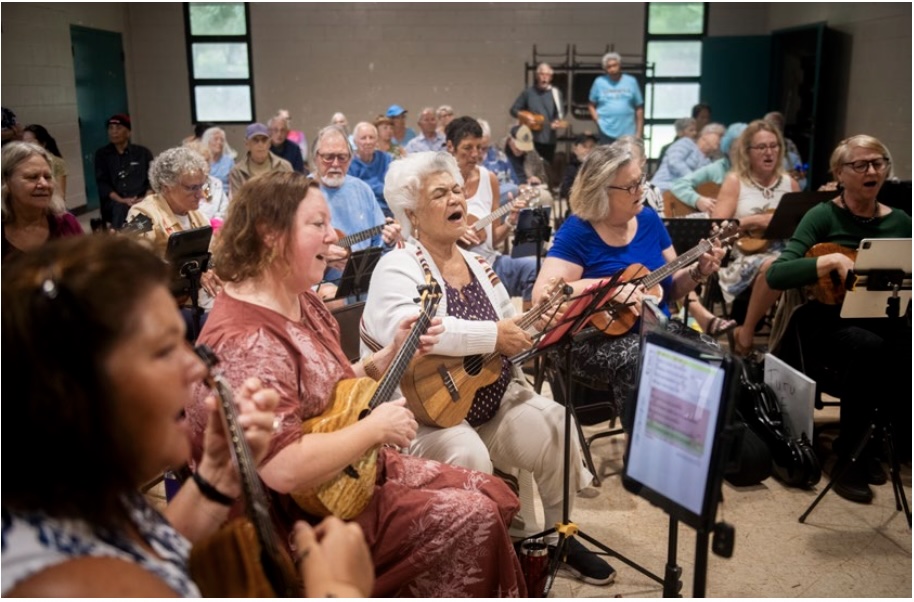
In a county rec center in the central Moloka‘i village of Kualapu‘u, about forty players and friends are arrayed in brown metal chairs for a weekly musical gathering
they call “Kanikapila Group Therapy.” Led by larger-than-life former Hawaiian
Airlines gate agent Waipa Purdy and a few other core regulars, the judgment-
free sessions attract a mixture of skilled local elders and earnest “snowbird”
retirees who spend several months each year on the Friendly Isle.
“We invite everybody, no matter how well you play,” says Waipa, who
during his nearly four decades with Hawaiian Airlines was famed among
passengers and staff for his generosity of aloha spirit. These days, the 80-year-
old former martial arts instructor and powerlifter sports a signature
holy-rocker look, replete with a black bandana tied around his long tresses,
dark shades and a honking silver crucifix around his neck.
Most of the participants on this Wednesday morning have an ‘ukulele
in hand, but there are also a few guitars and a lap steel player, plus
a couple of electronic keyboards, a guy blowing harmonica and another
tapping out rhythm with thimbles on an old laundry washboard. Waipa and
the other leaders go around the room, inviting each participant to choose a
song if they wish, with the repertoire ranging from traditional Hawaiian
classics to contemporary Island hits and sentimental country and folk standards.
Nearly everyone playing has an iPad in front of them, loaded with the
group’s meticulously compiled digital songbook. As each song gets called out,
a volunteer quickly scribbles its name and key on a small whiteboard and holds
it up over her head so everyone can look it up on their pads, an innovation that
has helped make jamming far more accessible to less experienced players.
Would-be jammers of previous eras had to be proficient enough to pick up tunes
on the spot, have a large number of songs committed to memory or rely on
cumbersome looseleaf binders packed with song sheets.
Between verses, Waipa and other leaders call on some of the best players
to p!‘ani, or take solos. A student of hula gets up to dance on a few songs, while
one of the snowbird regulars stands in a corner streaming the session from his
phone to the group’s Facebook page— another tech advance common to many
kanikapila communities these days. A woman with a classical guitar and
turquoise hair leans over and whispers, “You came to the best kanikapila! We
love it.”
After the session breaks up, a few of the core group head to the small cafeteria
in the island’s nearby hospital, which Waipa touts as having the “best lunch in
town for the best price.” Between bites of the daily special, he recounts how the
kanikapila sessions began in 2009, when he and his cousin Roy Horner started
getting together to play tunes with a couple of friends at the former Coffees of
Hawai‘i plantation and espresso shop in Kualapu‘u, which Horner managed.
Over the years the gathering just kept growing. On a big Wednesday
nowadays they might get more than a hundred people, with the crowd spilling
out onto the community center l!nai. Waipa’s h!nai (adoptive) sister, Ana
Char, who worked in finance on O‘ahu until she moved back to Moloka‘i the
first chance she got after she retired, points out that on a small island with
few programs for kūpuna (seniors), the kanikapila sessions offer a great
opportunity to stay active and social. “And for the snowbirds that come,” she
says, “it’s a chance for them to better learn about and respect our Hawaiian
culture. So I think it’s good not only for our community, but the visitors as well.”
“You can play anything you like with us,” Waipa chimes in, “and if we
don’t know it then we’re gonna learn it. I always tell people, ‘Hey, the group’s got
your back. That’s why we call it ‘group therapy.’ What can I say? I love music,
and I love making people happy. That’s the key.” Remember that part from earlier about other kinds of ja communities flourishing in the Islands?
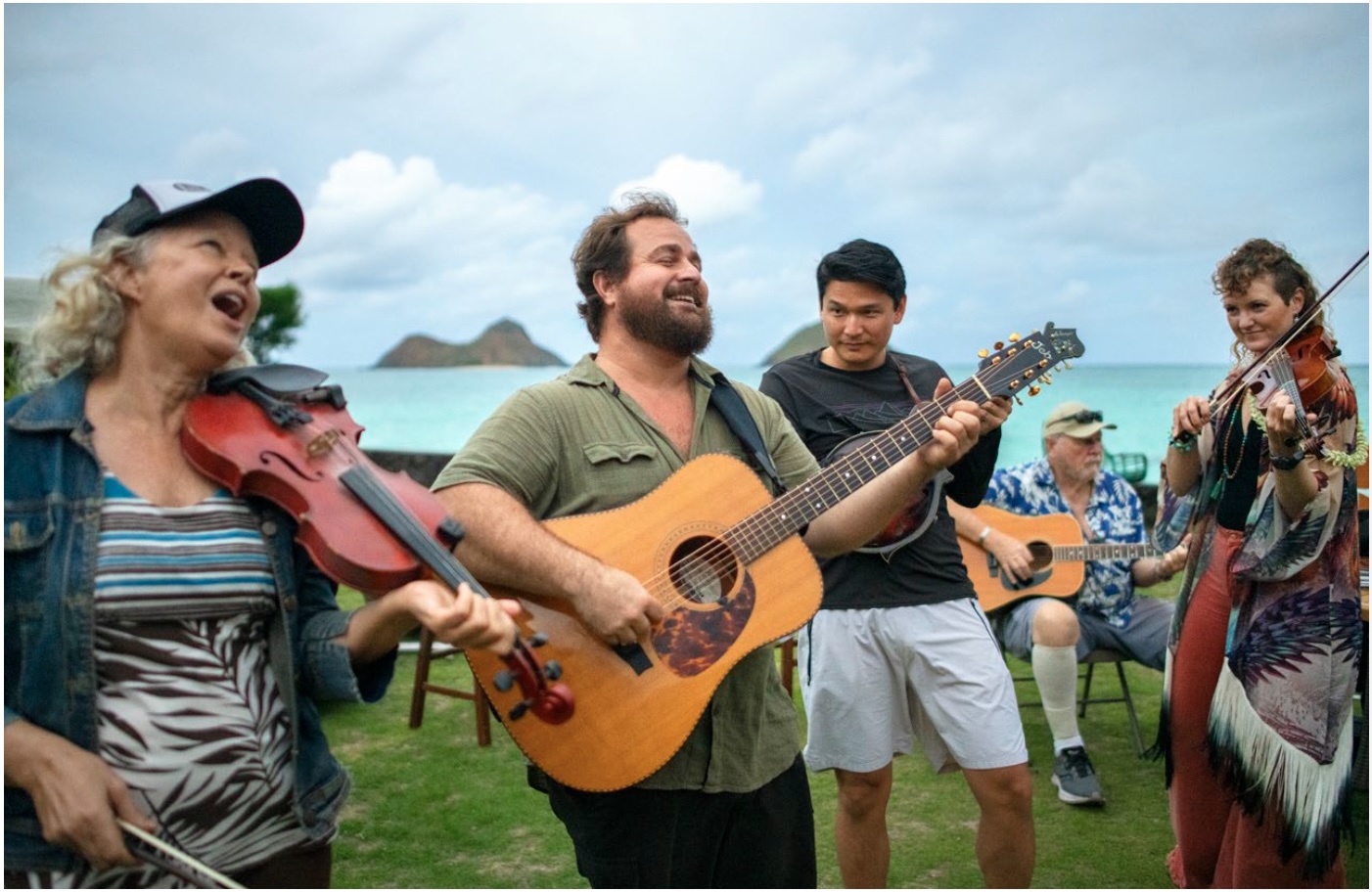
On an oceanfront lawn in the upscale East O‘ahu beach community of Lanikai,
with the twin Mokulua islets silhouetted against the fading light out over the water,
a circle of about a dozen jammers cradle mandolins, fiddles, guitars, banjos, a
stand-up bass and assorted other old-timey acoustic instruments. The occasion
is one of the regular open jam sessions promoted by the organization Bluegrass
Hawai‘i, which fosters a tight-knit community of several hundred traditional
folk and country music enthusiasts throughout the Islands.
Fiddler Lesley Kline, who hosts Bluegrass Hawai‘i’s semimonthly
Old Time Jam focused on vintage barnyard favorites with titles like
“Muskrat” and “Pig in a Pen,” says that Hawaiian kanikapila and American
folk traditions—and indeed various jam cultures worlwide—share similar
roots of “people throughout history just getting together at home to make music
purely for their own entertainment. So after a long day of farmwork and that
kind of thing, people would get together on the porch with their families and
neighbors and play.”
Kline says that, much like Hawaiian slack key and other roots
styles, bluegrass music—which first evolved in Appalachia in the 1940s
as a blend of rural European- and African-American styles—also enjoyed
a resurgence during the folk revival wave of the 1960s and ’70s, sparking
an ongoing passion for the genre. “In that era, a lot of young people did
start rediscovering some of the older Appalachian folk traditions and going,
‘Oh my god, this stuff is amazing,’ you know?” she says. “So they started
playing that music and hanging out with the old-timers, and eventually
taking the music into some newer directions themselves.”
The session at the beach house in Lanikai is Bluegrass Hawai‘i’s monthly
“Half Fast Jam,” tailored to those who are still developing their skills or prefer
playing a broader palette of acoustic material. This includes what might be
termed the hippie wing of the folk jam scene—adherents of the peace-and-love
lifestyle who in most cases were first drawn to explore traditional music
through the influence of psychedelic jam bands like the Grateful Dead, who
folded lots of old-time folk tunes into their cosmic mélange. Not that there
hasn’t been friction over the years between hippie jammers and bluegrass
traditionalists of a more conservative bent, mind you. But there’s no need to
dredge all that up here. Suffice it to say that at this jam, there is copacetic
coexistence between hippiefied versions of traditional tunes like “I Know You
Rider” or “Deep Ellum Blues” and more orthodox fiddle-oriented numbers like
“Soldier’s Joy” or “Arkansas Traveler,” with a few countrified covers of
contemporary Hawaiian standards like “Waimanalo Blues” thrown into the mix.
The high-energy host of the Lanikai jam, Bluegrass Hawai‘i President
Candis Burton Thomas, is a developing mandolin player who lived in Northern
California before moving to Hawai‘i with her late husband in 2007. Candis
says she was never really around people playing instruments socially until a
musician boyfriend introduced her to jam culture in the late 1990s. “For
the first time, I started seeing people playing in the corner at parties,” she
says, “and I thought, ‘Hey, I want to be with the cool kids.’ To me, jamming is a
great way of socializing, but also using your brain. At the end of the night, you
feel like you did more than just hang out; you feel like you’ve learned something.”
Candis says her favorite thing about Hawai‘i’s bluegrass scene is how open
and welcoming it is compared with workshops and jam events she’s been
to elsewhere, where a more competitive vibe often left her feeling terrified to
step forward and play. “Here, people are still smiling and welcoming even when
I struggle,” she says. “I think that’s the thing that’s so special about this
community, which I haven’t felt as much anywhere else.”
Plucking the stand-up bass at the Half Fast Jam is a regular on the
scene named Rand Anderson, a multi- instrumentalist and producer with
a wide-ranging professional music background and a trucker hat atop
his long hair. Through his Chee Hoo Records label, Anderson has put out
several recordings with artists he first met at the popular jam campouts that
Bluegrass Hawai‘i puts on a couple of times a year. His compilation of original
tunes called Island Time earned multiple nominations in last year’s
Na Hōkū Hanohano Hawai‘i music awards, including a finalist berth for
contemporary acoustic album of the year. To capture the genuine feeling
of a backyard jam, Rand says,“We recorded the album in parks, parking
lots, porches, living rooms—all over the place. It was pretty wild. And all of
the musicians went into the sessions ‘cold,’ without a chance to rehearse the
songs beforehand, to create a sense of spontaneity.”
Rand’s latest effort, Hawaiian Grass, features some of his favorite
Hawaiian songs reimagined with bluegrass styling and instrumentation.
“Now we’re starting to cross-pollinate with some of the Hawaiian kanikapila
folks,” he says. “I’d actually love to put on a ‘hulabilly’ festival sometime to try
to mash it up a little bit.”
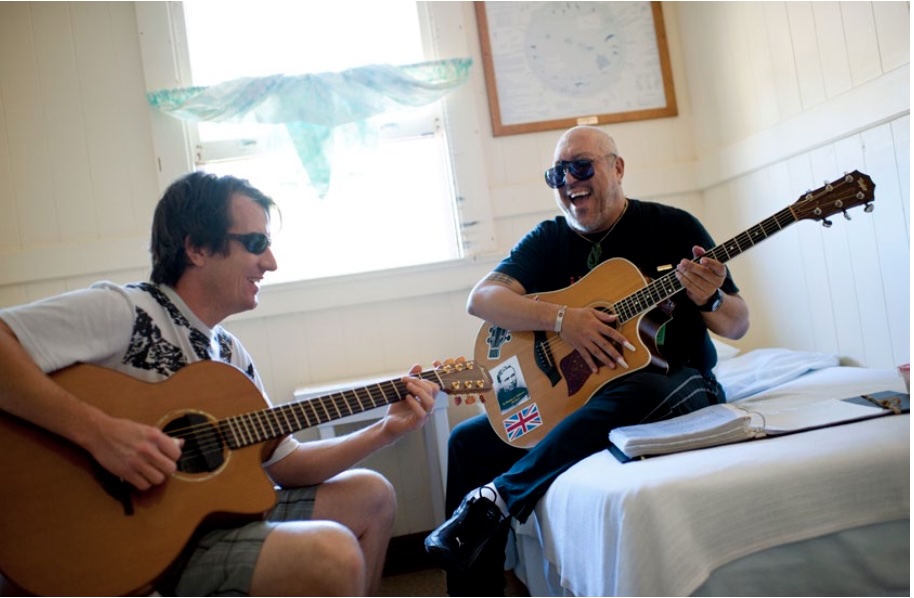
One artist who already has a foot in two di!erent musical
worlds is Stephen Inglis, best known locally as a leading slack key player but
with an alter-ego as a psychedelic guitar shaman in the mold of the Grateful
Dead’s Jerry Garcia—just a lot more clean-cut. At one point, Inglis was in
a band formed by Dead drummer and Kaua‘i resident Bill Kreutzmann, and
lately he’s been touring the tie-dye circuit frequently with a quintet of Dead-
affiliated heavy hitters going by thename Skeleton Crewe.
During his early childhood, Stephen’s social-activist parents were
involved in the ultimately unsuccessful fight to save Hale Mohalu, a medical
housing facility on O‘ahu for patients who formerly had been confined at
the notorious isolation facilities on Moloka‘i’s remote Kalaupapa Peninsula
before they were cured of Hansen’s disease, or leprosy. The protests to
try to prevent the state from evicting the patients and demolishing Hale
Mohalu are considered to be one of the emblematic social struggles of the
Hawaiian Renaissance era.
Stephen remembers being strongly affected by the music the residents and
their supporters would play together when his family went to visit the facility
every Sunday. “I was only seven when they came in and arrested everybody
and bulldozed the place,” he says. “But I vaguely remember it was a mix of
Hawaiian music and protest folk songs like ‘Down by the Riverside.’ That kind
of stuff.” The spirit of those kanikapila sessions stayed with him later in life,
when he took up guitar and began spending a lot of time playing with
friends at parties or beach campouts.
These days, Stephen doesn’t have much time or energy left over for casual
jamming between his road tours on the continent and eight to ten lounge
gigs a week when he’s at home. But he treasures the times when he and
other performers are able to grab some time to play just for fun backstage. His
favorite kanikapila of all, he says, is an early-morning jam that Ledward
Kaapana leads for the instructors at an annual week-long slack key and ‘ukulele
workshop on Maui. “Uncle Led is like a super morning person,” Stephen says.
“By five in the morning, he’s the first one in the pavilion, ready to jam with the
other teachers. And of course we all set our alarms to be there on time, because
the chance to jam with Led is golden no matter how tired you are.”
Whether it’s Hawaiian kanikapila, psychedelic rock, free jazz or any other
jam genre, Stephen says, “There’s definitely a shared aesthetic in any kind
of group improvisation thing. Whether you’re the one taking a solo or not,
everybody is just listening and bouncing off each other in a kind of musical
conversation. It teaches you how to react and adapt in the moment, especially if
you’re playing with people of varying skill levels. When you get that clicking
on all cylinders, it’s like, ‘Wow, okay, this is a whole different level.’ And that
can really help you grow as a performer.”
At a weekly kanikapila under a cluster of pop-up tents in central
Honolulu’s Ala Moana Beach Park, a mixed plate of jammers is putting
improvisational theory into practice without even thinking about it. This
jam is an amplified one, with everyone plugged into little battery-powered
amps—another tech advance that is transforming jam culture. The song
repertoire here spans the essential local appetite, from traditional and
contemporary Hawaiian to country, sentimental oldies and soft ’70s rock,
plus the occasional religious praise song. The vibe is very beachy, with lots
of sunglasses and visors, random park people wandering through the tents and
a few mellow pooches curled up among the instruments.
One of the gathering’s instigators, retired special forces combat medic
and later civilian registered nurse Danny Roe, says it all started about
ten years ago, soon after he had moved to the island. He was at the park to go
paddling and overheard a couple of the guys playing. “They were amazing
musicians, so I just sat and listened for a while and then wound up playing
with them regularly,” he recalls. “After a couple of years, I told them that I
wanted to start a kanikapila around the motto ‘Keep Live Music Alive,’ and they
were like, ‘Have at it, man.’ So I started putting the word out, and it’s just kept
growing and evolving. That’s what I love about it.”
Asked what kind of rewards he thinks people get from jamming, Danny
doesn’t hesitate: “It’s the fellowship, the commonality and the sense of
regeneration, renewing our spirits through music. It’s all kinds of people
coming together in musical oneness. I just wish everybody could come and
experience this kind of aloha.” hh